

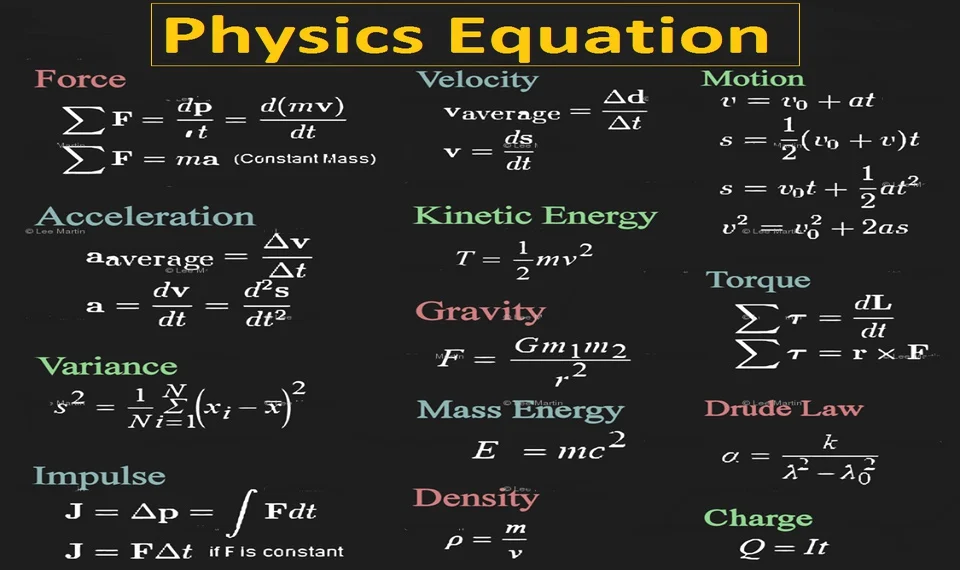

🎓 Unleash Your GCSE Physics Potential: Essential Equations to Master 🔬
🎉 Hey there, students (📚), parents (👨👩👧👦), tutors (✏️), and teachers (🏫)! Are you ready to conquer GCSE Physics? 🚀 Let’s dive into the key equations you’ll need to ace your exams!
🌟 Newcomers: Your GCSE Physics Survival Kit 🧰
🔰 Newton’s Laws of Motion
1. F=ma: Force equals mass times acceleration 💪
2. F=ma: Change in momentum equals force times time 🏃♂️🏃♀️
3. F=kx: Spring Force = Spring Constant x Extension 🎠
💡 Pro Tip: Practice solving problems involving these equations using different scenarios. Apply them in real-life situations to enhance understanding.
🌟 The Quantum Leap: Advanced GCSE Physics Equations 💡
🔰 E=mc²: Energy equals mass times the speed of light squared uteranium
🔰 Ohm’s Law: V=IR, I=V/R, R=V/I ⚡️
🔰 Gravitational Potential Energy: PE = mgh 🌋
💡 Pro Tip: Use a combination of these equations to solve more complex problems. Break down multi-step problems into smaller, manageable pieces.
🌟 Encouraging Success: Tips for Students, Parents, and Tutors 🎓
🔰 Personalised Learning: Tailor study plans to suit individual learning styles and strengths.
🔰 Revision Tips: Regularly revise and practice past papers to build confidence.
🔰 Motivation Boost: Set achievable goals and reward yourself for progress.
🔰 Parent Support: Encourage an open dialogue about challenges and successes.
🔰 Online Tutoring: Leverage online resources and tutoring platforms for additional support.
🌟 Teachers’ Insights: Sharing the Knowledge 🏫
🔰 Learning Strategies: Encourage active learning and hands-on experience.
🔰 Inspire Curiosity: Make lessons engaging by connecting concepts to real-life examples.
🔰 A-Level Physics: Begin introducing advanced topics in GCSE to ease the transition.
FAQs ❓
How can I apply these equations in real life?
Practice problems that involve everyday situations, such as calculating the force needed to stop a moving car or the potential energy stored in a stretched rubber band.
What’s the best way to revise for GCSE Physics?
Regularly revise, solve practice problems, and review difficult topics with a tutor or study group.
How can I make learning Physics more engaging?
Connect concepts to real-life examples, use visual aids, and encourage hands-on learning.
How can I best support my child in Physics?
Encourage open dialogue, provide a quiet study space, and offer help when needed.
What online resources can I use for additional support?
Explore tutoring platforms like Tutor GP for personalised learning and additional support.
How can I enhance my teaching methods for Physics?
Incorporate active learning, use real-life examples, and encourage curiosity.
How can I stay motivated during my Physics studies?
Set achievable goals, reward yourself for progress, and surround yourself with supportive peers.
How can I prepare for A-Level Physics if I’m struggling with GCSE Physics?
Seek additional support through tutoring, focus on understanding fundamental concepts, and practice regularly.